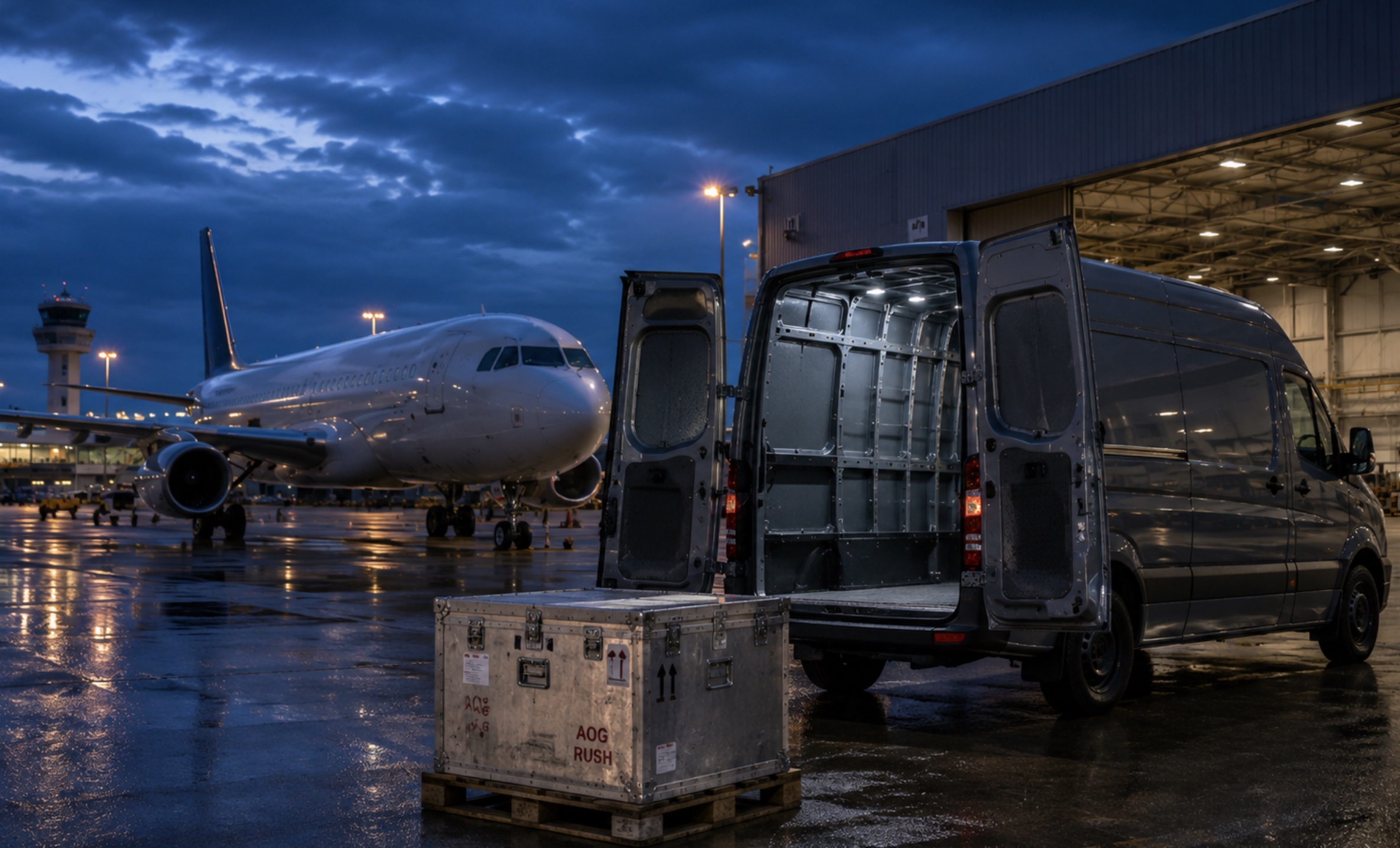
The real cost may include employees waiting, production slowing, technicians returning to a job site, appointments being rescheduled, emergency replacement orders, missed customer commitments, or valuable freight sitting at an airport terminal.
That is why urgent transportation decisions should not be based on mileage and freight rates alone.
The better question is:
What will this delay cost the business if the shipment does not arrive when it is needed?
Nor’East Xpress provides direct expedited freight transportation throughout New Jersey and the Northeast for shipments that cannot tolerate unnecessary terminals, transfers, or scheduling delays.
A Freight Delay Rarely Affects Only Transportation
When freight is delayed, the effect often spreads beyond the shipping department.
A missing component may affect production. A late medical device may disrupt an installation. A replacement part may leave a field-service technician waiting. A missed airport recovery may result in storage charges and a delayed final delivery.
The shipment itself may be small, but the operation depending on it may be significant.
Potential consequences can include:
- Production downtime
- Idle employees
- Technician waiting time
- Missed installation appointments
- Overtime labor
- Rescheduled crews
- Emergency replacement orders
- Airport storage charges
- Detention or waiting charges
- Customer penalties
- Lost sales
- Delayed testing
- Missed project milestones
- Damage to a customer relationship
The true cost depends on the shipment, industry, deadline, and operation. Not every delay creates a major financial loss, but the possible consequences should be considered before choosing the transportation method.
The Difference Between Shipping Cost and Delay Cost
Transportation cost is usually easy to identify.
A shipper receives a quote and compares it with other service options.
Delay cost is more difficult because it may be spread across several departments.
For example, consider a component needed for equipment repair.
The standard shipping option may save several hundred dollars. But if the part arrives one day later, the company may also face:
- A technician remaining on-site
- A second service visit
- Additional travel
- Lost operating time
- An unhappy customer
- A missed contractual deadline
In that situation, the lower freight rate may create the higher total cost.
Expedited transportation should not automatically be used for every shipment. It should be considered when the expected cost of waiting is greater than the additional cost of a direct move.
Production Downtime
Manufacturing operations often depend on a continuous flow of parts, tools, controls, sensors, motors, and materials.
When one required item is missing, the impact can extend beyond the value of the item itself.
A delayed component can affect:
- Production employees
- Maintenance personnel
- Assembly schedules
- Customer orders
- Downstream suppliers
- Quality-control processes
- Scheduled shipments
- Equipment utilization
A part that fits inside one carton may be supporting machinery, employees, and customer commitments worth far more than the transportation charge.
Direct expedited transportation can move the required item from the supplier, distributor, warehouse, or airport directly to the facility without waiting for a traditional freight network schedule.
Technician and Field-Service Delays
HVAC, elevator, electrical, automation, telecommunications, construction, and equipment-service companies frequently schedule technicians around the availability of a specific part.
When the freight is late, the technician may be unable to complete the job.
The business may then face:
- Billable labor that cannot be completed
- A second service appointment
- Additional mileage and travel time
- Customer downtime
- Schedule disruptions for other jobs
- After-hours or overtime work
In these situations, expedited transportation is not simply moving a part faster.
It may be helping the service company avoid repeating the entire visit.
Missed Installations and Project Milestones
Installations often depend on several suppliers and teams arriving in the correct sequence.
A delayed shipment may affect:
- Construction schedules
- Equipment installations
- Trade-show setups
- Facility openings
- Technology deployments
- Medical-equipment installations
- Government projects
- Customer acceptance testing
When a required piece of equipment or material does not arrive, other teams may be unable to continue.
The cost can include rescheduling labor, extending equipment rentals, delaying inspections, or missing the customer’s required completion date.
A direct transportation option may be appropriate when the delivery is connected to a fixed installation window.
Customer Commitments
Some freight delays do not stop production or leave a technician waiting.
They affect a promise made to a customer.
A distributor may have committed to replacing a product. A manufacturer may have promised a component by a certain date. A supplier may be supporting a customer’s urgent request.
When that promise is missed, the cost may be difficult to measure.
It could affect:
- Customer trust
- Future orders
- Supplier evaluations
- Contract renewals
- Online reviews
- Referral opportunities
- The customer’s own operation
Expedited transportation cannot correct every supply-chain problem, but it may help protect the final commitment after a delay has already occurred elsewhere.
Airport Storage and Recovery Delays
Air freight continues to generate costs after the aircraft lands.
An imported shipment may require customs release, regulatory review, airline availability, cargo-handler authorization, terminal payment, and ground recovery.
If the shipment is available but not recovered within the terminal’s allowed period, storage charges may begin to accumulate.
Delays can also occur when:
- The shipment has arrived but is not available
- Customs release is incomplete
- FDA review remains pending
- The delivery order has not been issued
- Terminal charges have not been paid
- Pickup authorization is missing
- The driver is not listed
- The final delivery facility is closed
Before dispatching a ground carrier, the importer, customs broker, freight forwarder, and cargo handler should confirm that the freight is fully released and physically available.
Nor’East Xpress supports qualifying airport recovery and line-haul transportation through EWR, JFK, PHL, IAD, and other Northeast cargo facilities.
Inventory Shortages and Emergency Replenishment
Businesses may use expedited freight when inventory falls below the level needed to support operations or customer demand.
This may occur because of:
- A forecasting error
- Unexpected sales
- A supplier delay
- Damaged inventory
- A missed inbound connection
- A quality-control rejection
- A customer emergency
- An incorrect shipment
The decision to expedite should consider the consequences of remaining out of stock.
For some products, waiting may be acceptable. For others, the shortage may interrupt production, delay service, or send customers to another supplier.
Expedited transportation can move replenishment directly without waiting for a multi-stop or terminal-based schedule.
Healthcare and Life Sciences Delays
Healthcare, pharmaceutical, laboratory, and medical-device shipments may support patient care, testing, research, production, or scheduled procedures.
Possible shipments include:
- Medical devices
- Diagnostic equipment
- Clinical trial materials
- Laboratory supplies
- Packaged pharmaceutical products
- Replacement equipment
- Manufacturing components
- Quality-control samples
These shipments may require precise receiving contacts, handling instructions, confidentiality, chain-of-custody documentation, or temperature-qualified packaging.
A late delivery may affect more than inventory. It can disrupt a scheduled procedure, laboratory workflow, clinical milestone, or manufacturing operation.
Nor’East Xpress supports qualifying medical and pharmaceutical transportation throughout New Jersey and the Northeast.
How Direct Expedited Transportation Reduces Uncertainty
Traditional freight networks are designed to combine shipments from multiple customers.
That model may involve:
- Terminal transfers
- Cross-docking
- Consolidation
- Scheduled departures
- Multiple vehicles
- Shared trailer capacity
- Several tracking systems
This can be cost-effective for routine freight with flexible delivery requirements.
It may create too much uncertainty for a shipment connected to a production line, technician, installation, airport recovery, or fixed customer deadline.
Nor’East Xpress uses a direct point-to-point model for accepted shipments.
One shipment. One vehicle. One driver.
The freight is picked up and transported directly toward the destination without unnecessary terminal transfers or cross-docking.
This can reduce exposure to:
- Missed terminal connections
- Additional freight handling
- Misrouting
- Delayed scans
- Lost paperwork
- Multiple carrier handoffs
- Unclear responsibility
Direct transportation does not eliminate traffic, weather, facility delays, or unexpected road conditions. It reduces the number of outside schedules and transfers affecting the shipment.
Why Sprinter Transportation Can Be Cost-Effective
Many urgent shipments do not require a tractor-trailer.
A dedicated Sprinter may be appropriate for freight such as:
- One or several pallets
- Crated equipment
- Manufacturing components
- Electronics
- Medical devices
- Aerospace parts
- HVAC and elevator components
- Packaged pharmaceutical products
- Airport cargo
- Trade-show materials
- Emergency replacement parts
Using a vehicle matched to the size of the shipment may provide a more practical direct option than reserving larger equipment.
A Sprinter can also be useful for:
- Urban deliveries
- Facilities with limited vehicle access
- Smaller loading areas
- Tight service entrances
- Direct airport-to-consignee moves
- Regional same-day transportation
The correct equipment depends on the piece count, weight, dimensions, loading method, unloading method, securement requirements, and site conditions.
Nor’East Xpress reviews these details before accepting the assignment.
Learn more about expedited Sprinter van direct shipping.
When Expedited Freight May Not Be Necessary
Expedited transportation is not automatically the right choice.
Standard freight may be more appropriate when:
- The delivery date is flexible
- The shipment can tolerate terminal handling
- Inventory is available at the destination
- No employees or equipment are waiting
- A delay will not affect a customer commitment
- The freight is not difficult to replace
- Cost is more important than transit certainty
- The customer has enough time to use a scheduled network
The goal is not to expedite every shipment.
The goal is to identify the shipments where direct transportation can prevent a larger operational expense.
A Simple Cost-of-Delay Evaluation
Before selecting a transportation option, ask:
What happens if the shipment is one hour late?
Will anyone be waiting? Will the receiving appointment be missed? Will terminal storage begin?
What happens if it is one day late?
Will production stop? Will a technician need to return? Will the installation be rescheduled?
Who is affected?
Consider employees, contractors, customers, patients, production teams, receiving facilities, and downstream operations.
Can the shipment be replaced?
A custom component, prototype, medical device, or specialized part may not be easily replaced.
How much handling can the freight tolerate?
Fragile, sensitive, high-value, or difficult-to-replace cargo may benefit from fewer transfers.
What is the total cost of waiting?
Include labor, downtime, missed appointments, penalties, emergency purchases, storage, customer impact, and the cost of correcting the problem later.
Once those costs are understood, the transportation decision becomes clearer.
Communication Also Has Financial Value
When freight is urgent, a lack of information creates additional problems.
A customer who does not know where the shipment is may be unable to:
- Schedule receiving staff
- Notify a technician
- Adjust production
- Update a customer
- Extend facility hours
- Prepare unloading equipment
- Reschedule an appointment
Nor’East Xpress provides direct communication at important shipment milestones, which may include:
- Driver dispatched
- Estimated arrival at pickup
- Arrival at origin
- Freight loaded
- Departure from pickup
- Updated estimated delivery time
- Arrival at destination
- Delivery completed
- Electronic proof of delivery
GPS-based tracking can also be supported when required for the assignment.
Accurate information allows the customer to make operational decisions before a transportation problem becomes a larger business problem.
Credentials Supporting Time-Critical Transportation
Nor’East Xpress maintains credentials, training, and insurance that support customer onboarding and qualifying freight assignments:
- MC 1696833
- USDOT 4342378
- SCAC NPFJ
- TSA security vetting
- TWIC credential
- SAM registration
- CAGE code
- HIPAA training
- Bloodborne Pathogens training
- HAZCOM training
- $100,000 cargo coverage
- $1 million commercial auto liability coverage
The relevance of each qualification depends on the shipment and facility.
For example:
- TSA security vetting may support qualifying air-cargo work
- TWIC may support qualifying maritime-facility access
- SAM and CAGE may support government contracting and subcontracting
- HIPAA training supports awareness involving sensitive healthcare information
- Bloodborne Pathogens training may be relevant to properly packaged specimens
- HAZCOM supports chemical-hazard awareness
These qualifications do not replace facility authorization, cargo releases, product permits, dangerous-goods documentation, temperature requirements, or shipment-specific insurance review.
They help customers verify the identity, authority, insurance, security readiness, and training of the carrier completing the ground move.
Information Needed for an Expedited Quote
To evaluate the shipment and provide an accurate quote, Nor’East Xpress needs:
- Pickup address
- Delivery address
- Requested pickup time
- Required delivery time
- Number of pieces
- Total weight
- Dimensions of each piece
- Commodity description
- Declared value
- Palletized or loose freight status
- Loading method
- Unloading method
- Dock or ground-level access
- Appointment requirements
- Driver-assist expectations
- Facility-access instructions
- Temperature requirements
- Dangerous-goods status
- Proof-of-delivery requirements
Complete information helps determine whether the shipment fits safely, whether the vehicle is appropriate, and whether additional services or charges may apply.
The Smarter Decision Is Based on Total Cost
Expedited freight usually costs more than a routine transportation option.
That does not automatically make it more expensive.
When a late shipment creates downtime, repeated labor, missed appointments, storage charges, customer penalties, or lost business, the lower transportation rate may produce the higher total cost.
The decision should be based on the value of the shipment’s timing, not only its weight or size.
When the consequences of waiting are greater than the price of direct transportation, expedited freight may be the smarter financial and operational choice.
Need Time-Critical Freight Transportation?
Nor’East Xpress provides expedited, same-day, airport recovery, final mile, hot shot, and direct-route transportation throughout New Jersey and the Northeast.
To request a quote, provide the pickup location, destination, piece count, weight, dimensions, commodity, declared value, and required delivery time.
Request an expedited freight quote
Nor’East Xpress
MC 1696833 • USDOT 4342378 • SCAC NPFJ
TSA Security Vetted • TWIC Credentialed • SAM Registered • CAGE Coded
$100,000 Cargo Coverage • $1 Million Commercial Auto Liability
Built for the Northeast. Delivered with purpose.