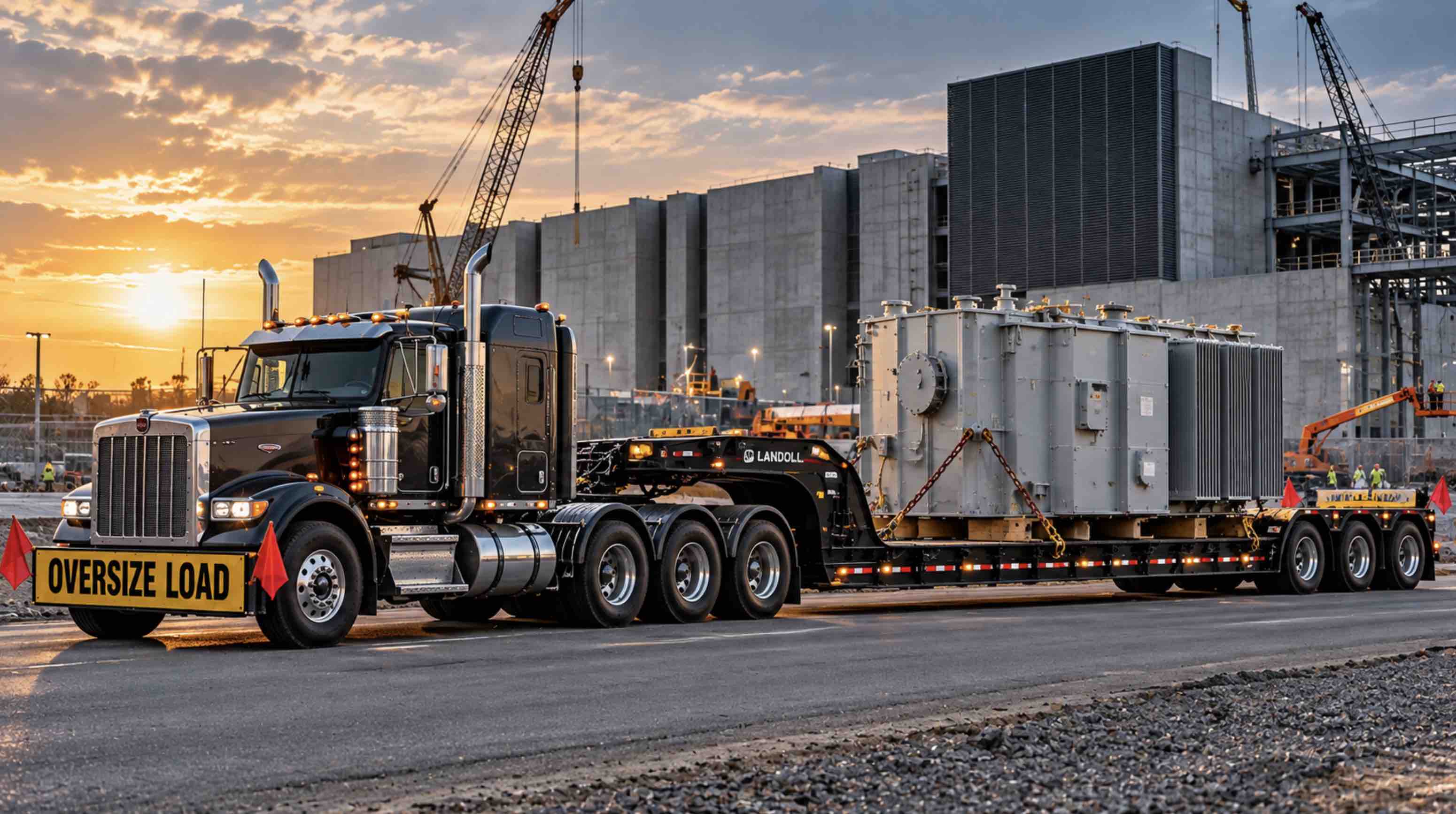
But moving oversized or overweight freight involves far more than finding a truck capable of carrying the weight.
Equipment specifications, weight distribution, route restrictions, bridge clearances, loading requirements, site access, and timing all need to be considered before a shipment moves.
At Nor’East Xpress, a Landstar Agency, based in Central New Jersey, we help businesses coordinate heavy haul transportation, oversized freight, specialized equipment movements, and project-critical deliveries throughout the Northeast and beyond.
Our approach begins with understanding the freight, the destination, and what the project actually requires.
What Is Heavy Haul Transportation?
Heavy haul transportation generally involves moving unusually large or heavy freight that requires specialized equipment, routing, permits, or transportation planning.
An oversized shipment may exceed standard width, height, or length restrictions. An overweight shipment may exceed applicable gross vehicle or axle weight limits.
Not every large piece of equipment qualifies as an oversized load.
Some industrial machinery can move on conventional flatbed or step-deck trailers. Other shipments require lowboys, removable goosenecks, multi-axle configurations, perimeter trailers, or specialized transportation arrangements.
Typical heavy haul and specialized freight includes:
- Large data center generators, transformers, and cooling equipment
- Industrial presses, manufacturing machinery, and production systems
- Power generation equipment and substation components
- Aerospace assemblies and defense manufacturing equipment
- Excavators, cranes, and large construction machinery
- Prefabricated electrical buildings and industrial modules
- Large tanks, vessels, and structural components
The correct transportation solution depends on the shipment's dimensions, weight, configuration, origin, destination, and handling requirements.
The freight determines the equipment. Not the other way around.
Why Heavy Haul Transportation Matters in the Northeast
The Northeast combines major industrial markets, advanced manufacturing, construction activity, power infrastructure, and growing demand for data center capacity.
New Jersey connects manufacturers, equipment suppliers, ports, utilities, and major metropolitan construction markets.
Pennsylvania's manufacturing base, energy resources, industrial development, and data center projects create transportation requirements for large electrical, mechanical, and industrial equipment.
New York and New England contribute additional demand through aerospace, defense, manufacturing, electrical infrastructure, and commercial construction.
The region also presents distinctive transportation challenges.
Older bridges, restricted roadways, low-clearance structures, urban congestion, seasonal conditions, and state-specific permitting requirements can affect routing and scheduling.
A shipment that appears straightforward on a map may require an entirely different route once its loaded dimensions and axle weights are considered.
As discussed in our article about why Northeast transportation experience matters, regional infrastructure, facility access, and local operating conditions can influence the entire transportation plan.
Successful heavy haul transportation in the Northeast depends on understanding these constraints before equipment is dispatched.
1. Data Center Equipment Transportation
Data center construction and expansion create substantial transportation requirements for large electrical and mechanical equipment.
Modern data centers require far more than servers, networking equipment, and telecommunications infrastructure.
Behind every facility is an extensive network of power generation, electrical distribution, cooling, backup systems, and mechanical equipment.
Heavy haul and specialized transportation may be necessary for:
- Industrial generators and backup power systems
- High-capacity electrical transformers
- Industrial chillers and cooling equipment
- Uninterruptible power supply (UPS) systems
- Battery energy storage systems
- Prefabricated electrical rooms
- Modular power distribution systems
- Large HVAC assemblies
- Structural and mechanical infrastructure
Each shipment presents different transportation challenges.
A generator may require a low-deck trailer and specialized loading arrangements.
A transformer may need multi-axle equipment and carefully evaluated weight distribution.
A prefabricated electrical building may exceed standard height or width limits, requiring specialized routing and permits.
Data Center Construction Requires Coordinated Transportation
Large data center projects involve equipment arriving from different manufacturers and suppliers over multiple construction phases.
Freight may originate from manufacturing facilities, ports, storage locations, or distribution centers.
Some components arrive early in construction. Others must be delivered immediately before installation or commissioning.
Transportation planning should account for:
- Equipment manufacturing and release dates
- Pickup and delivery windows
- Construction milestones
- Crane and rigging availability
- Specialized trailer requirements
- Site access and ground conditions
- Delivery sequencing
- Changes to project schedules
A delayed generator or transformer can affect more than its own delivery date.
It may also disrupt installation crews, electrical contractors, and other scheduled work.
For these projects, transportation planning should begin well before equipment is ready for pickup.
Why the Northeast Data Center Market Is Important
Data center development creates opportunities for far more than server and networking equipment suppliers.
Large construction projects require manufacturers, electrical contractors, mechanical contractors, power equipment suppliers, rigging companies, utilities, and transportation providers to coordinate their work.
New Jersey, Pennsylvania, New York, and neighboring states form an interconnected market for many of these services.
Even when a data center project is located outside New Jersey, its generators, transformers, cooling systems, or electrical equipment may originate from manufacturers or suppliers elsewhere in the Northeast.
Those movements create transportation requirements that extend across state lines.
For heavy haul shipments, the challenge is not simply covering the distance. It is coordinating equipment, permits, route restrictions, and delivery conditions around the project schedule.
2. Industrial Machinery Transportation
The Northeast has a substantial manufacturing base spanning pharmaceuticals, medical devices, aerospace, electronics, chemicals, metals, food production, and advanced manufacturing.
These industries depend on large production equipment that may require specialized transportation.
Common industrial machinery shipments include:
- Manufacturing presses
- CNC machines and machining centers
- Injection molding equipment
- Industrial fabrication systems
- Production-line machinery
- Manufacturing automation equipment
- Compressors and processing systems
- Large packaging and production assemblies
Industrial machinery transportation involves challenges beyond overall weight.
A machine may have an unusual center of gravity, concentrated weight, sensitive components, specific lifting points, or complex loading requirements.
Manufacturing facilities may also have restricted entrances, limited maneuvering areas, or dock configurations that cannot accommodate conventional loading procedures.
Plant Relocations and Manufacturing Expansion
Manufacturing equipment is frequently moved during plant relocations, facility expansions, production-line upgrades, and new equipment installations.
These projects may involve several shipments requiring different trailer configurations.
Transportation planning should consider machine dimensions, operating weight, center of gravity, lifting instructions, securement requirements, factory loading arrangements, destination access, and installation schedules.
Not every manufacturing shipment requires heavy haul equipment.
Smaller replacement parts, industrial components, and production-critical materials may be better suited to dedicated or expedited freight transportation.
The objective is to match the transportation method to the equipment and the operational consequences of a delay.
3. Power Infrastructure and Transformer Transportation
The Northeast's electrical infrastructure supports manufacturing operations, commercial facilities, transportation systems, utilities, and growing data center power requirements.
Power generation projects, electrical grid improvements, facility expansions, and utility upgrades frequently require specialized transportation.
Heavy haul shipments may include:
- Large power transformers
- Turbines and turbine components
- Substation equipment
- Industrial generators
- Electrical switchgear assemblies
- Power distribution modules
- Battery energy storage infrastructure
- Large electrical enclosures
Some of these components are extremely heavy. Others have dimensions that create significant routing challenges.
Large transformers may require specialized multi-axle transportation arrangements, engineered load distribution, and detailed route evaluations.
Delivering Equipment to Substations and Utility Sites
Substations and utility construction locations are not conventional receiving facilities.
Site access may be limited. Ground conditions may require evaluation. Unloading may depend on cranes, specialized rigging, or installation crews.
Transportation schedules may also need to align with planned utility work, construction phases, or equipment replacement programs.
The delivery plan must account for the entire operation, including how the equipment will enter the site and reach its unloading location.
Reaching the property is not always the same as completing the delivery.
Why Transformer Transportation Requires Special Planning
Large power transformers can be among the most challenging pieces of electrical infrastructure to transport.
Their weight may be concentrated over a relatively compact footprint, while their dimensions can make bridge clearances, turning movements, and access roads important considerations.
Depending on the equipment, some accessories may be removed for transportation, and the manufacturer may specify particular lifting, supporting, or handling arrangements.
Transportation planning should consider the manufacturer's instructions, actual shipping configuration, equipment weight, route limitations, and unloading requirements.
For especially heavy or complex transformers, additional engineering and specialized transport configurations may be necessary.
The transportation plan must reflect the individual transformer rather than relying on a standard equipment category.
4. Aerospace and Defense Equipment Transportation
The Northeast supports an extensive network of aerospace manufacturers, defense contractors, precision manufacturers, and specialized industrial suppliers.
These companies may need transportation for large assemblies, specialized production equipment, ground-support machinery, and high-value components.
Typical shipments include:
- Large aerospace assemblies
- Aircraft components
- Ground-support equipment
- Manufacturing tooling
- Industrial test equipment
- Defense manufacturing machinery
- Oversized fabrication assemblies
Some aerospace components are unusually long or wide but relatively lightweight.
Others combine significant weight with specialized handling requirements.
Custom supports, protective packaging, securement arrangements, high cargo values, and security requirements may all influence the transportation plan.
Depending on the freight, additional documentation, regulatory review, or transportation authorization may also be necessary.
Specialized Handling and Project Requirements
Aerospace and defense equipment may involve long manufacturing lead times and significant replacement costs.
Damage or delays can affect production schedules, assembly operations, and downstream deliveries.
The transportation plan should address the equipment's dimensions, packaging, securement, handling instructions, cargo value, and destination requirements.
Not every aerospace shipment requires heavy haul equipment.
Smaller, time-sensitive aircraft components and replacement parts may require an entirely different approach.
Our article, When an Aircraft Is Waiting: Why AOG Logistics Leaves No Room for Delay, explains how direct transportation and airport recovery can support time-critical aviation operations.
Whether the shipment is an oversized aircraft assembly or a smaller component needed for maintenance, the transportation solution must reflect the actual freight and delivery requirements.
5. Construction Equipment Transportation
Major infrastructure, commercial construction, utility, and industrial development projects throughout the Northeast depend on transporting large construction machinery.
Equipment may move between dealerships, rental facilities, storage locations, manufacturing facilities, and active jobsites.
Common shipments include:
- Excavators
- Cranes and crane components
- Bulldozers
- Wheel loaders
- Paving equipment
- Drilling machinery
- Large compressors
- Specialized construction equipment
Equipment dimensions, operating weight, attachments, and loading requirements determine the appropriate transportation method.
Some machinery can be loaded onto removable gooseneck trailers using its own power.
Other equipment requires cranes, specialized loading procedures, or preparation before transportation.
Construction Site Delivery Planning
Unlike established warehouses, construction sites may have temporary access roads, uneven surfaces, restricted entrances, and changing operating conditions.
Delivery scheduling may depend on site preparation, unloading equipment, or coordination with other contractors.
Transportation planning should consider whether the site can safely accommodate the truck and trailer and whether unloading arrangements have been confirmed.
An on-time arrival provides little value if the site cannot receive the equipment.
Specialized Heavy Haul Trailers and Equipment
Successful heavy haul transportation starts with matching the equipment to the shipment.
Through Landstar's network, Nor’East Xpress can help evaluate specialized transportation equipment for qualifying loads.
Common trailer configurations include:
Flatbed Trailers
Flatbeds are used for industrial machinery, structural materials, construction equipment, and other freight suitable for open-deck transportation.
Step-Deck Trailers
Step decks provide a lower main deck than conventional flatbeds, allowing additional height clearance for certain machinery and industrial equipment.
Double-Drop and Lowboy Trailers
These configurations offer lower deck heights for taller machinery and oversized equipment requiring additional vertical clearance.
Removable Gooseneck (RGN) Trailers
RGNs are commonly used for large construction machinery and industrial equipment requiring low deck heights or drive-on loading capabilities.
Extendable and Stretch Trailers
These trailers accommodate exceptionally long components, including structural assemblies, industrial equipment, and other overlength freight.
Multi-Axle Trailers
Multi-axle configurations distribute weight across additional axles and can support particularly heavy equipment, subject to route and permit requirements.
Perimeter Trailers
Perimeter trailers use specialized load-support configurations for certain exceptionally large, tall, or heavy components, including transformers and other infrastructure equipment.
The appropriate trailer depends on the actual freight, load distribution, route, and transportation requirements.
Not every oversized load requires the most complex equipment.
The objective is to select a configuration that meets the shipment's dimensional, weight, loading, and routing requirements.
Heavy Haul Route Planning, Permits, and Escort Requirements
Route planning is one of the most important differences between heavy haul freight and conventional truckload transportation.
An oversized or overweight shipment may not be authorized to travel along the shortest or most familiar highway route.
Depending on the load, transportation planning may require evaluating:
- Overall loaded height, width, length, and weight
- Axle and axle-group weights
- Bridge and roadway restrictions
- Overhead clearances
- Turning radii and road geometry
- State and local permits
- Pilot car and escort requirements
- Travel-hour limitations
- Utility coordination
- Road construction and temporary closures
Requirements vary among New Jersey, Pennsylvania, New York, Connecticut, and other jurisdictions.
A permit issued by one state does not automatically authorize movement through another.
Some shipments also require coordination with local authorities or infrastructure operators.
The route must be evaluated against the actual loaded configuration before transportation begins.
Why Northeast Routing Can Be Especially Complicated
The Northeast includes dense metropolitan areas, aging infrastructure, industrial corridors, ports, major interstates, and local roads with varying restrictions.
A conventional truckload shipment may use a direct interstate route that is unsuitable for an oversized load.
Bridge clearances, axle restrictions, road geometry, or local access limitations may require alternative routing.
For certain shipments, the final few miles to a construction site or industrial facility may involve more planning than much of the highway portion.
Regional knowledge helps identify these issues early.
Why Heavy Haul Projects Require Early Planning
Heavy haul transportation involves more than a pickup address, delivery address, and requested date.
Before arranging a shipment, important questions include:
- What is the equipment's exact weight?
- What are the dimensions?
- Is the load divisible?
- Where is its center of gravity?
- Are technical drawings or lifting diagrams available?
- What trailer configuration is needed?
- How will the equipment be loaded and unloaded?
- Are permits or escort vehicles required?
- Are there restrictions at the destination?
- Is the shipment high-value or subject to special handling?
- Does delivery need to align with a construction milestone?
These details determine equipment selection, transportation feasibility, routing, scheduling, and cost.
Incomplete shipment information can lead to delays, equipment changes, and additional expense.
The earlier transportation requirements are established, the more effectively the move can be planned.
Multi-Phase Data Center and Infrastructure Project Logistics
Large infrastructure projects rarely involve a single shipment.
A data center campus, manufacturing expansion, electrical substation, or major construction project may require equipment arriving from multiple suppliers over an extended period.
Some loads may move on flatbed or step-deck equipment.
Others require lowboys, removable goosenecks, multi-axle trailers, or highly specialized configurations.
Coordinating these shipments may involve:
- Supplier pickup scheduling
- Equipment planning
- Shipment sequencing
- Route and permit coordination
- Construction milestone alignment
- Crane and rigging coordination
- Delivery appointment management
- Shipment tracking and communication
- Coordination with onsite project teams
For these projects, transportation needs to support the broader construction or installation schedule.
A delay affecting one critical component can create consequences beyond the transportation itself.
The best approach is to understand the project's transportation needs early enough to coordinate the resources required for each phase.
Heavy Haul and Expedited Transportation: When Timing Matters
Not every oversized shipment is planned months in advance.
Equipment failures, manufacturing delays, infrastructure repairs, unexpected project changes, and compressed construction schedules can create time-sensitive transportation requirements.
A replacement generator, industrial component, or critical piece of machinery may need to move urgently.
But expedited heavy haul transportation is different from conventional expedited freight.
Permits, route approvals, escort requirements, specialized equipment availability, and legal travel restrictions may still determine when a shipment can move.
Urgency does not eliminate these requirements.
The transportation plan must identify the earliest realistic solution while maintaining necessary safety and compliance controls.
For smaller shipments that can move legally on conventional equipment, same-day transportation throughout the Northeast may provide an appropriate alternative.
For larger project-critical equipment, dedicated specialized capacity and advanced planning may be necessary.
The objective is to move the freight as efficiently as possible without overlooking the requirements that make the shipment specialized.
Heavy Haul Transportation Across New Jersey, Pennsylvania, New York, and the Northeast
Nor’East Xpress is based in Central New Jersey, with a regional transportation focus covering the Northeast and Mid-Atlantic.
Heavy Haul Transportation in New Jersey
New Jersey supports transportation demand from industrial manufacturers, utilities, equipment suppliers, ports, construction projects, and technology infrastructure.
Key markets include Middlesex, Mercer, Monmouth, Somerset, Union, Essex, Bergen, and Hudson counties.
Industrial corridors around Edison, South Brunswick, Cranbury, Newark, Elizabeth, and the greater New York metropolitan area create opportunities for specialized equipment transportation.
Heavy Haul Transportation in Pennsylvania
Pennsylvania's manufacturing, energy, construction, and industrial markets support a broad range of specialized transportation requirements.
Important corridors include:
- Lehigh Valley
- Philadelphia metropolitan area
- Bucks and Montgomery counties
- Central Pennsylvania
- Northeastern Pennsylvania
- Harrisburg region
- Pittsburgh industrial region
Data center construction, industrial development, electrical infrastructure, and machinery transportation are important potential sources of project freight.
Heavy Haul Transportation in New York
New York's manufacturing, construction, utility, and infrastructure markets often require careful transportation planning.
Relevant markets include New York City, Long Island, the Hudson Valley, Albany, Syracuse, Rochester, and Buffalo.
Urban access restrictions, bridges, tunnels, and local routing requirements can add complexity to oversized shipments.
Heavy Haul Transportation in Connecticut and New England
Connecticut, Massachusetts, and surrounding New England states support aerospace, defense, advanced manufacturing, utilities, and infrastructure projects.
Specialized transportation may be required for machinery, industrial assemblies, electrical equipment, and construction components moving between suppliers, manufacturers, and project sites.
Heavy Haul Transportation in the Mid-Atlantic
Delaware, Maryland, and Virginia connect Northeast industrial suppliers with broader manufacturing, energy, infrastructure, and data center markets.
Through Landstar's transportation network, Nor’East Xpress can evaluate qualifying specialized freight opportunities throughout these regions and across North America.
Why Work With Nor’East Xpress, a Landstar Agency?
Heavy haul transportation involves more than locating a trailer with sufficient capacity.
It requires understanding the freight, evaluating equipment requirements, identifying possible restrictions, coordinating transportation resources, and maintaining communication throughout the process.
Nor’East Xpress brings practical transportation experience and a direct agency relationship to customers requiring specialized freight solutions.
Our transportation background began with moving freight from the road, gaining firsthand experience with demanding pickup and delivery windows, facility requirements, delays, communication, and the operational details that affect every shipment.
Today, as a Landstar agency, we combine that perspective with access to Landstar's broader transportation network and specialized heavy haul support resources.
For qualifying shipments, those resources can help address complex transportation requirements involving specialized equipment, routing, permitting, and operational coordination.
Our focus begins with understanding the equipment and the project.
Whether the shipment involves a data center generator, manufacturing press, electrical transformer, aerospace assembly, or construction machine, the objective is the same.
The right equipment. The right route. The right plan.
Choosing a Heavy Haul Transportation Partner in the Northeast
When evaluating a transportation provider for oversized or overweight freight, the initial rate should not be the only consideration.
Shippers should understand how the proposed transportation plan addresses:
Equipment: Is the trailer appropriate for the actual shipment dimensions, weight, and loading requirements?
Routing: Have bridge clearances, road restrictions, turning requirements, and access conditions been considered?
Permits: Who will coordinate the necessary permits and transportation authorizations?
Safety: Are the equipment, operators, loading procedures, and securement arrangements appropriate for the freight?
Scheduling: Does the plan account for site readiness, unloading, and project deadlines?
Communication: Who will provide shipment updates and manage changes?
Risk: Have cargo value, insurance requirements, and special handling needs been evaluated?
Capacity: Can the transportation resources support additional shipments if the project expands?
A well-developed transportation plan should answer these questions before the shipment is dispatched.
Heavy Haul Transportation for the Northeast's Next Generation of Infrastructure
Data centers, electrical infrastructure, advanced manufacturing, aerospace, defense, and construction projects create complex transportation requirements across the Northeast.
These industries have different operational needs, but many of their transportation challenges are similar.
Large equipment.
Complex dimensions.
Restricted routes.
Critical delivery schedules.
Specialized handling.
And little room for assumptions.
Nor’East Xpress, a Landstar Agency, coordinates heavy haul transportation, oversized freight, specialized equipment, and project-critical deliveries throughout New Jersey, Pennsylvania, New York, Connecticut, and the broader Northeast and Mid-Atlantic.
Whether you're moving a transformer, generator, industrial press, aerospace component, or construction machine, the transportation plan should be developed around the actual freight and destination requirements.
Because when a shipment supports critical infrastructure, the planning matters just as much as the delivery.
Need Heavy Haul Transportation in the Northeast?
Tell us what equipment you're moving, where it needs to go, and when it needs to arrive.
Provide the shipment's dimensions, weight, pickup and delivery locations, loading requirements, and any known site restrictions.
We'll review the transportation requirements and evaluate appropriate solutions through Landstar's specialized freight network.
Request a Heavy Haul Transportation Quote →
Nor’East Xpress, a Landstar Agency
Heavy Haul | Specialized Freight | Oversized Transportation | Industrial Equipment | Data Center Logistics | Project-Critical Deliveries